New Zealanders feel more confident with money (but there’s a catch)
Confidence was tracking up
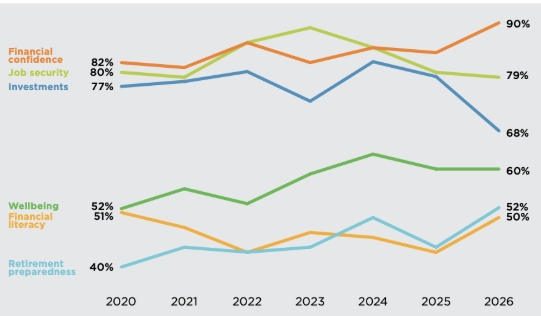
Ninety percent of New Zealanders surveyed said they felt confident making financial decisions – the highest level recorded in the Index’s seven-year history.
Even more striking: the number of people who described themselves as extremely confident nearly doubled in a single year, from 17% in 2025 to 31% in 2026.
Worth noting, though, that the survey was conducted in March and April 2026, before the cost pressures of recent months had fully flowed through to households. As the report itself highlights, this could be a confident moment rather than a lasting shift.
Source: Financial Services Council of New Zealand – Financial Resilience Index, June 2026
But financial pressure hadn’t gone away
Feeling confident about your finances and feeling financially secure aren’t always the same thing. The 2026 Index highlights that difference.
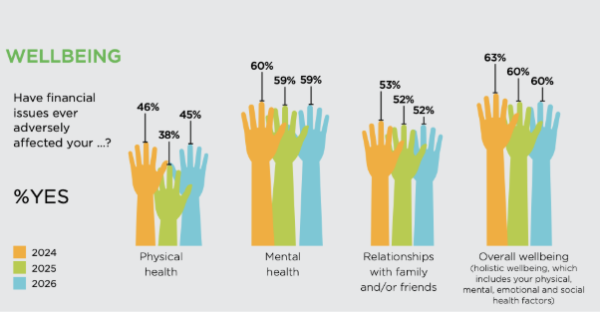
Around 6 in 10 participants said their finances had affected their overall wellbeing, a figure that’s climbed steadily since 2020. Specifically, 59% of respondents said financial issues have impacted their mental health, 52% said the same of their relationships, and 45% reported an impact on physical health – up from 38% the year before.
Regular money concerns have eased a little at the start of 2026, but they’re still quite common: 65% of New Zealanders surveyed worry about money daily, weekly or monthly. Only 18% said they rarely or never think about it. Younger generations, in particular, continue to carry a disproportionate share of that anxiety, even as the overall numbers improve.
Source: Financial Services Council of New Zealand – Financial Resilience Index, June 2026
Many were relying on a thin safety net
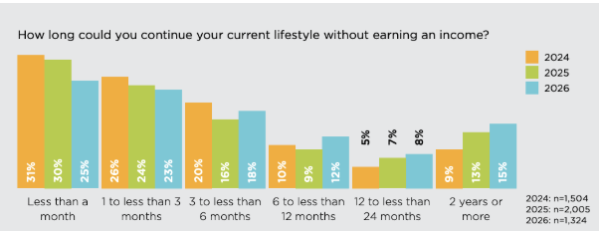
Twenty-five percent of respondents said they could sustain their current lifestyle for less than a month without an income. That’s down from 30% last year and 31% in 2024. Still, a quarter of the population living that close to the edge is nothing to brush off.
Then there’s the $5,000 question. Only 55% said they could cover an unexpected expense of that size within a week, without going into debt – a figure that’s barely moved in the past three years.
Household savings have declined this year too, meaning Kiwis’ all-important financial buffer is thinning, even as everyday confidence rises.
Source: Financial Services Council of New Zealand – Financial Resilience Index, June 2026
How can you build your own financial resilience?
You can build financial resilience in different ways. Yes, an emergency fund is crucial. But a buffer doesn’t have to mean a large pile of savings – which, let's be honest, can be difficult to put aside when the cost of living is already high.
A good place to start? Know your numbers. Even a rough idea of how long you could cover your expenses without an income is useful information.
From there, treat resilience as a work in progress rather than a box to tick. Something you build, review and adjust as life changes. Here’s where we can help.
Financial protection
Resilience can also mean preventing an unexpected illness, injury or loss of income from hitting your savings or derailing your plans. That's exactly what life, health and income protection insurance are for. The right level of cover depends on your income, your debts, who relies on you, and what you'd want covered if life took an unplanned turn. An Insurance Link adviser can help you work out what that looks like for you.
Your mortgage
How your mortgage is structured has a lot to do with financial resilience. The right structure can be the difference between manageable repayments and ones that stretch you thin the moment something changes. Whether that means finding room to pay it off faster or building in more flexibility, a Mortgage Link adviser can help you shape your mortgage around your needs and goals.
Your investments
According to this year’s Index, the share of New Zealanders holding any investments fell from 82% in 2024 to 68% in 2026. The FSC suggests it may reflect households pulling back to manage cost-of-living pressure. Understandable. But resilience is also about building your future, not just putting out today's fires. An Invest Link adviser can help you keep investing in a way that fits your current budget, your goals and your attitude to risk.
Turning confidence into resilience
Real resilience comes from knowing where you’re at and having a plan to close any gaps.
Wherever you're starting from, consider getting expert help.
Whether that's an Insurance Link adviser reviewing your protection, a Mortgage Link adviser looking at your mortgage structure, or an Invest Link adviser helping you build your nest egg, get in touch. We’re here to help.
Sources:
- Financial Services Council of New Zealand – Financial Resilience Index, June 2026
Methodology: 2026 data was collected between 13 March and 1 April, with 2,000 valid complete responses. As the survey only included respondents aged 18 or above, the estimated resident population of the sample is 4,160,850.
Disclaimer: Please note that the content provided in this article is intended as an overview and as general information only. While care is taken to ensure accuracy and reliability, the information provided is subject to continuous change and may not reflect current development or address your situation. Before making any decisions based on the information provided in this article, please use your discretion and seek financial advice.
A full disclosure statement for each Insurance Link Adviser is available on request and free of charge.